
1700s Life-Size Madonna Santos Cage Doll


Description
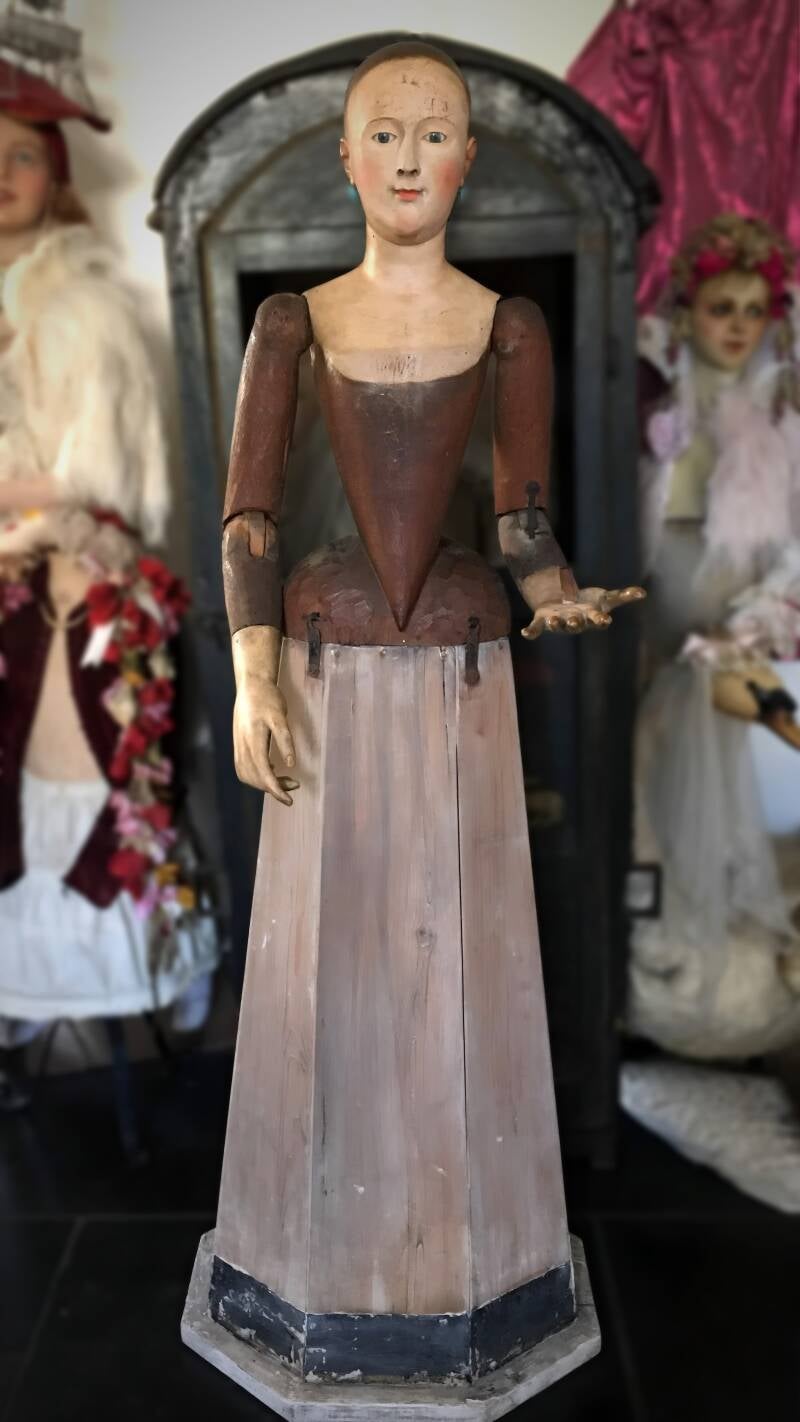
A majestic and exceedingly rare Life-Size Madonna Santos Cage Doll, dating from the early 1700s to circa 1750, carved in Italy for private devotional use. Standing in her full original height, this extraordinary figure embodies the serene yet solemn beauty associated with the Virgin of Sorrows.
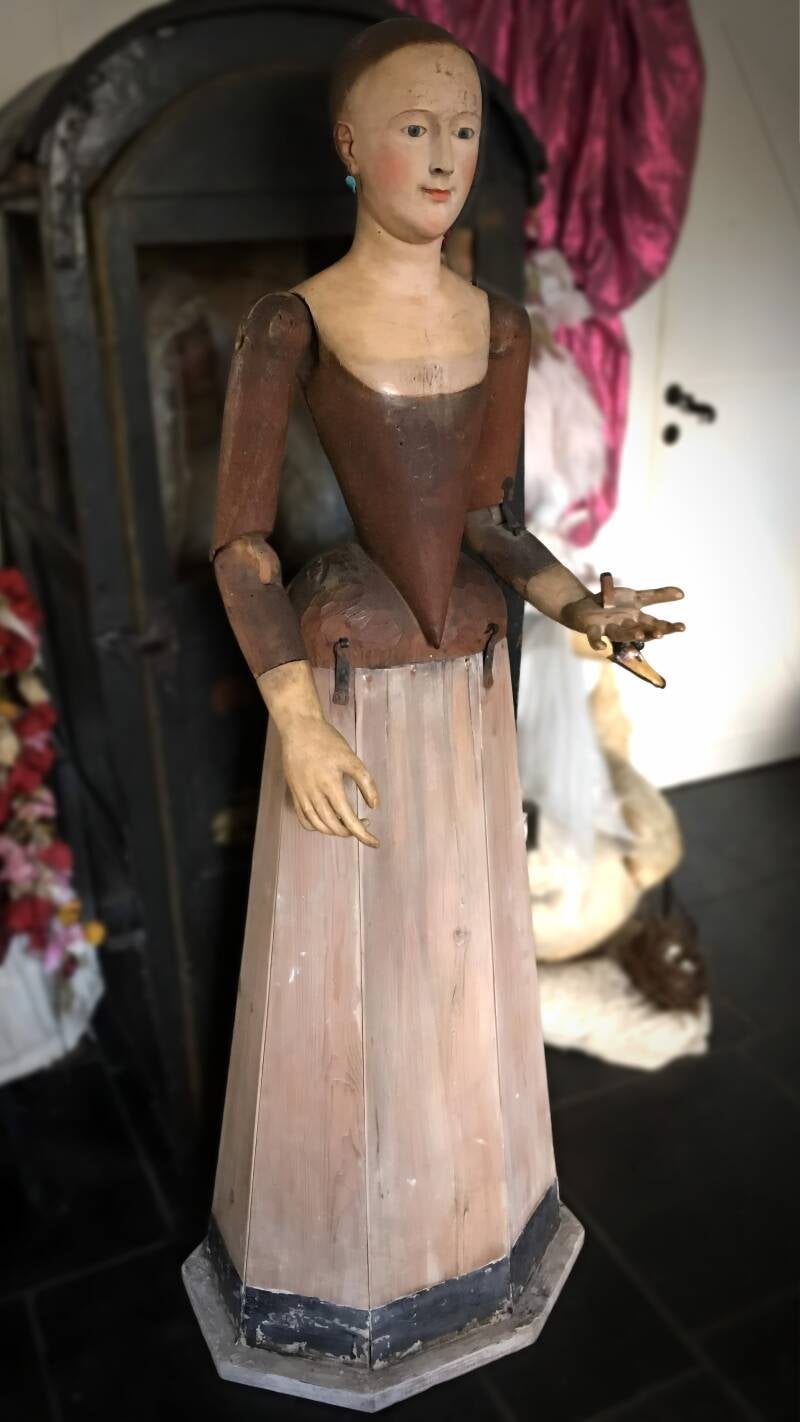
Carved in multiple sections from hardwood and finished in soft polychrome paint, she retains her original surface with a remarkable, untouched patina earned over nearly three centuries. Her bust separates from the cage-form lower body, exactly as these early devotional mannequins were constructed. The torso is still joined to the conical wooden "skirt" by its original hand-forged iron hooks, a detail almost never preserved.
Her arms also retain their original iron articulation mounts. Notably, the left arm bears the surviving suspension hook and a wooden retaining peg—a rare and important detail demonstrating how she once held the Christ Child during feast days or private devotion. The original Baby Jesus figure has long since been lost to time, but its absence only emphasizes the authenticity of her centuries-old function.
Her face is breathtaking, with a beautifully modelled expression meant to capture a quiet, contemplative sorrow. She has hand-painted features, delicate rouge to the cheeks, finely drawn brows, and real glass inset eyes—a luxury reserved for high-status ecclesiastical sculpture. Unusually, she also features pierced ears, suggesting that she once wore devotional earrings offered by her patron.
Despite her great age, this magnificent Santos figure remains in exceptional, untouched condition. Rare, commanding, and incredibly atmospheric, she is a museum-level example of early 18th-century Italian sacred sculpture.
MUS-049
History
Santos figures—also called imagen de vestir, mannequin saints, or cage dolls—originated in the late 1600s and flourished throughout the 18th century in Spain, Portugal, and Italy. Their purpose was both devotional and ceremonial: they allowed worshippers to dress and adorn holy figures during the liturgical year, transforming the sculpted image to reflect feasts, mourning periods, or processions.
In Italy, where this example originates, life-size Santos dolls were exceptionally rare and costly. They were not made for ordinary parish churches but were commissioned by wealthy families, aristocrats, and the upper bourgeoisie for their private chapels or small oratories within their homes. These families often employed local sculptors to create a single figure that would remain with the household for generations—presiding over births, marriages, and funerals, and acting as a tangible focus of Catholic faith.
The cage-form construction of the lower body served a practical and symbolic purpose. Practical, because it allowed the figure to be dressed in voluminous silks or brocades without needing a fully carved body beneath; symbolic, because the hollow form permitted relics, ex-votos, or offerings to be stored discreetly within. The removable bust allowed caretakers to change garments seasonally or to reveal the sculptor’s work during restoration.
The iron hooks and articulated joints reflect early 18th-century ecclesiastical craftsmanship—strong, utilitarian, and made to withstand repeated dressing. The surviving hook and wooden peg on her left hand are particularly significant: they identify her specific role as a Madonna with Child, indicating that she once held a separately carved Infant Jesus during devotions.
Today, life-size Santos Madonnas from the early 1700s are extraordinarily scarce, as most were lost during wars, repurposed, or damaged over centuries of handling. To find one in this state—complete, imposing, and retaining her original polychrome surface—is a discovery worthy of a private museum.