

Articulated Artist’s Mannequin, circa 1800–1820


An Articulated Artist’s Mannequin
Attributed to the Circle of Paul Huot, Paris, circa 1800–1820
Historical Context
Paul Huot was a highly respected Parisian maker of articulated artist’s mannequins, active from the late 18th century into the early decades of the 19th century. Working in the tradition of the so-called mannequins perfectionnés, Huot supplied painters and sculptors with sophisticated lay figures that allowed for the careful study of anatomy, posture, and drapery at a time when access to live models was costly and often impractical.
These mannequins were not decorative objects, but professional tools—engineered with remarkable precision and durability. From Paris to St. Petersburg, Huot’s mannequins were considered the gold standard of their kind and were exported throughout Europe. In 1819, Huot was officially recognized for his Mannequin Perfectionné, praised by the Jury de l’Exposition for its exceptional “softness of movement,” achieved through refined ball-and-socket joints and flexible outer layers.
Although Huot rarely marked his early works, archival sources confirm that his mannequins commanded extraordinary prices. The genre painter August von der Embde, for example, paid the remarkable sum of 1,000 francs in 1817—nearly a full year’s salary—to have a Huot mannequin shipped from Paris to Kassel. Such figures were reserved for wealthy artists or major studios; even renting one was expensive, and waiting lists were common.
Paris, in this period, was the absolute center of mannequin production. Makers such as Nicolas Anseaume (Huot’s predecessor), Jean-Jacques Perrot, and later Léopold Chéradame and Louis Hallé contributed to the evolution of these articulated figures, but Huot’s work remained the benchmark against which all others were measured.
Construction and Anatomy
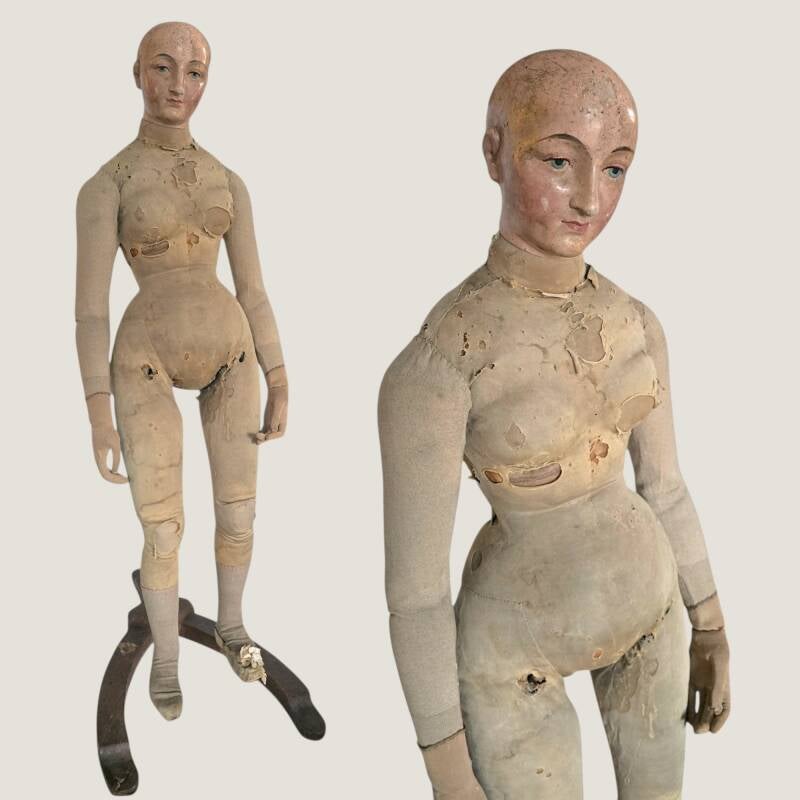
This mannequin is a full-size articulated figure, approximately 160–170 cm in height. Beneath her surface lies an ingenious anatomical skeleton, primarily constructed of oak, with metal and wooden joints that allow for a wide range of naturalistic poses. The structure is strong enough to support heavy garments—often exceeding ten kilograms—while remaining perfectly balanced in a standing position.
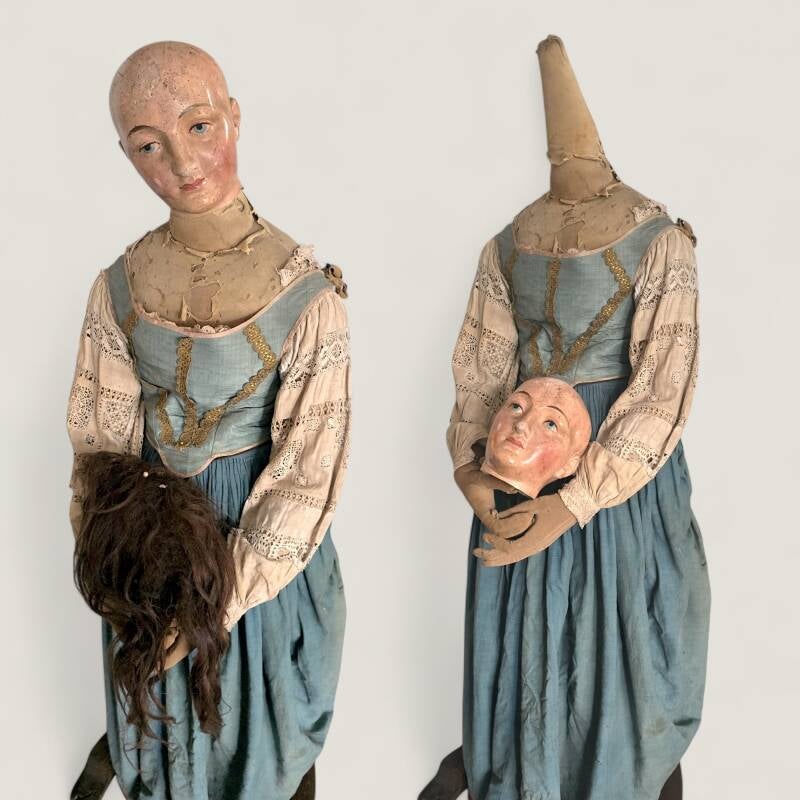
The skeleton is padded with horsehair and natural materials to give the body realistic volume. Over this, a knitted cotton jersey was applied to simulate human skin, sometimes finished with a thin silk stockinette for smoothness. The mannequin is secured to an original, heavy oak stand with a horseshoe-shaped base; iron bolts at the hips allow the figure to be fixed firmly in position. Old wormholes and multiple height-adjustment holes in the stand bear witness to decades of professional use.
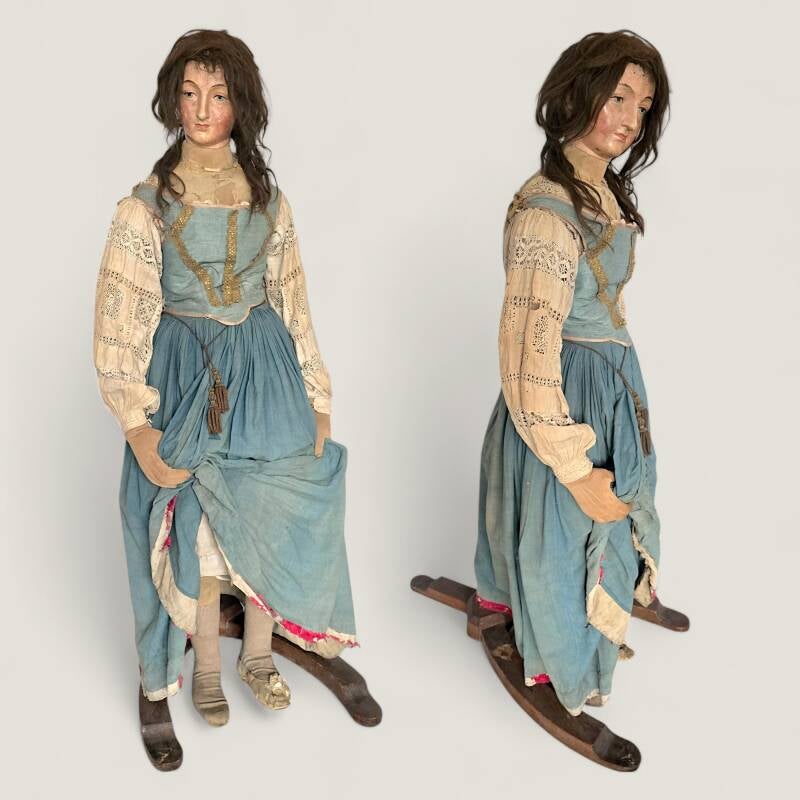
The head is made of painted papier-mâché and retains its original hand-applied finish. Remarkably, the mannequin still wears her original human-hair wig—an exceptionally rare survival.
Costume and Survival
Perhaps most extraordinary is that this mannequin has survived with her original, tailor-made clothing intact. The dress dates to the early Empire period (circa 1810) and fits her body with uncanny precision, confirming that it was made specifically for her. Her bodice, skirt, chemise, stockings, and even her delicate shoes remain with the figure—an almost unheard-of level of preservation.
Antique artist’s mannequins were utilitarian studio tools, often repaired, altered, or discarded once worn out. As a result, very few examples—especially those attributed to Paul Huot—have survived in such complete and evocative condition.
A Silent Muse
A silent muse, enveloped in the fragile echoes of a vanished Empire, she stands poised upon her oak pedestal. She is no doll, but an articulated enigma—her painted eyes carrying the quiet memory of Parisian studios, candlelit ateliers, and patient hours spent holding a single pose.
Dressed in the faded elegance of the early 19th century, she once bore the weight of heavy fabrics and artistic ambition alike. Beneath her worn jersey skin lies an ingenious mechanical soul, designed not to perform, but to endure.
Who last arranged her stance? Which artist studied her silhouette, traced her folds of fabric, and translated her stillness onto canvas? Her identity remains anchored only to the fragment of an old, illegible label—a mystery suspended between craftsmanship and time.
Such a mannequin will not be encountered again: a Huot-period articulated figure, on her original stand, with her original clothes—a rare survivor of the golden age of the mannequin perfectionné.