
Egyptian Revival Headdress with Peacock Crest



Egyptian Revival Headdress with Peacock Crest
France, circa 1870–1890
Possibly attributed to the circle of Bijouterie Fanchon, Paris
Description
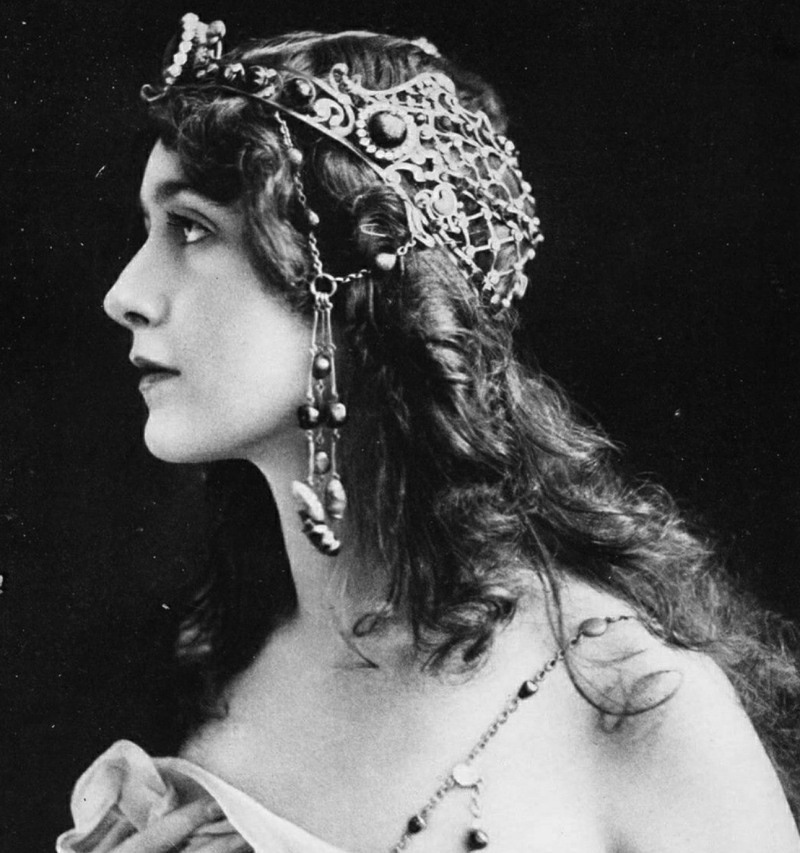
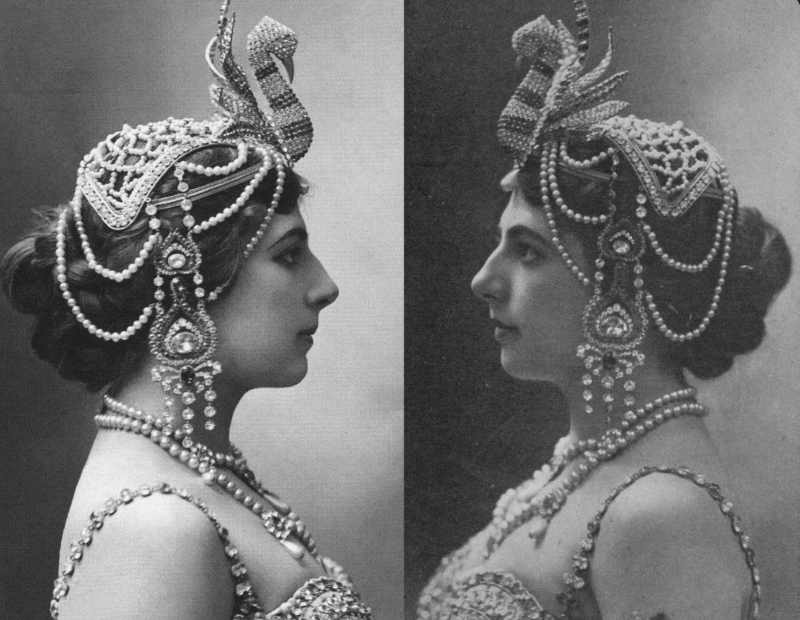
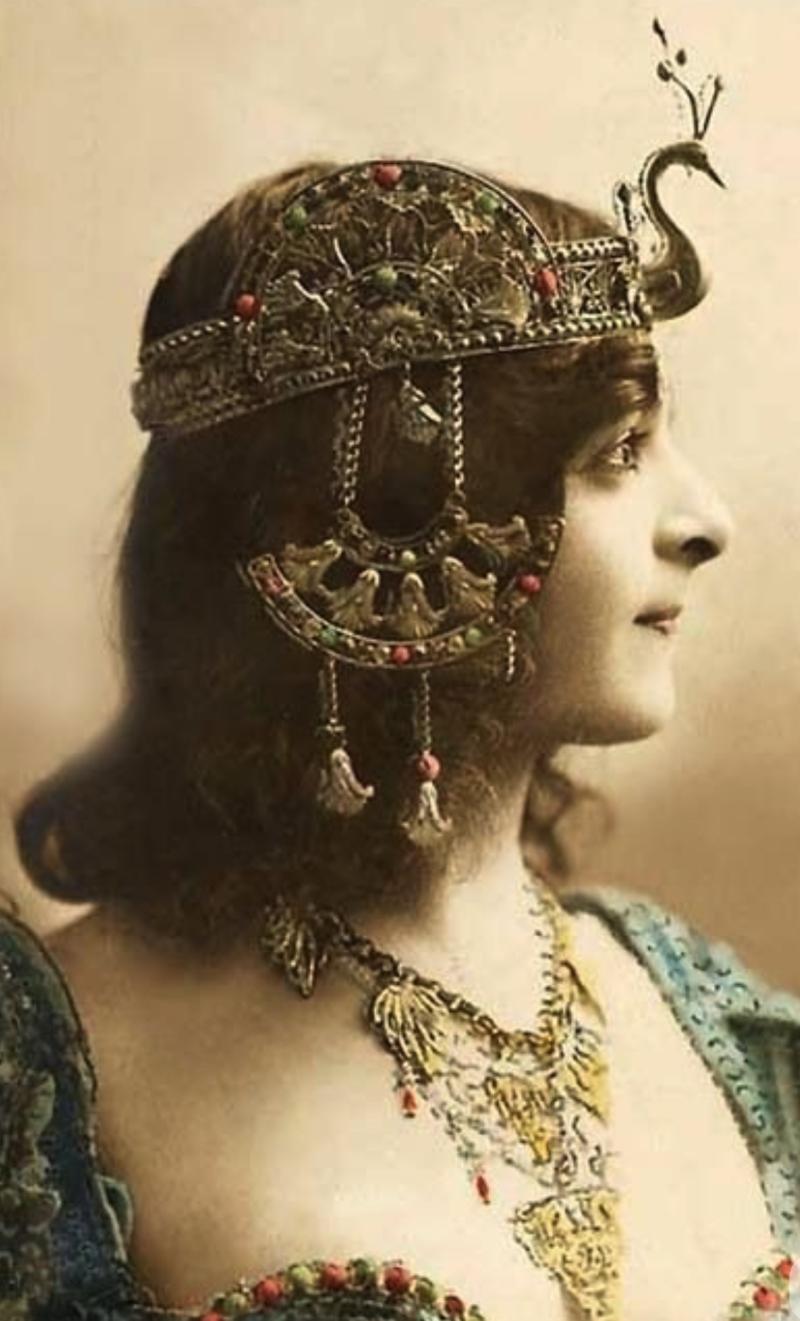
A highly elaborate Egyptian Revival theatrical headdress, composed of a finely woven gold-tone cap forming a soft, shimmering base.
The structure is enriched with an openwork lattice of gilded brass, set throughout with faceted black and clear stones. Large cabochon-style elements accent the sides and crown, while articulated chains with faceted drops cascade elegantly along the temples, designed to catch the light with movement.
At the front, a decorative band of alternating stones frames the face, enhancing the dramatic silhouette. The crowning feature is a sculptural peacock motif, richly set with rhinestones and dark accents, rising above the forehead in a gesture of regal display.
The interior construction remains remarkably light, reflecting its intended use for theatrical performance.
A striking and highly evocative example of late 19th-century stage adornment, blending Egyptian Revival symbolism with the opulence and theatricality of the Belle Époque.
A Relic of a Forgotten Stage
In the twilight of a bygone era, this headdress emerges like a relic from a dream—an object suspended between history and myth.
Finely woven threads of gold, like strands of captured sunlight, envelop the head in a shimmering veil. They fall softly around the face, catching the light with every movement, recalling the flicker of oil lamps in a theatre long since gone silent.
Set within this luminous structure are deep black stones—dark, watchful, and enigmatic. They gaze outward like the eyes of a forgotten deity, holding within them the stillness of eternity.
Above all, enthroned at the crest, rises the peacock. Its elegant neck arches skyward, adorned with glittering stones, as if guarding ancient secrets. It is not merely ornament, but symbol—a silent sentinel of immortality, beauty, and power.
This is not simply a headdress.
It is a transformation.
The Allure of the Egyptian Revival
The Egyptian Revival was not merely a fashion—it was an obsession.
Its first wave began in the early 19th century, following Napoleon’s expedition to Egypt in 1798. Scholars, artists, and travellers returned to Europe with drawings of temples, obelisks, and hieroglyphs, igniting a fascination that would ripple through architecture, jewelry, and the decorative arts.
But it was the discovery of the tomb of Tutankhamun in 1922 that reignited the world’s imagination. Gold, lapis, scarabs, and sacred symbols flooded into the language of Art Deco design, merging ancient mysticism with modern glamour.
This headdress stands at the intersection of these worlds—rooted in the romantic theatrical traditions of the late 19th century, yet anticipating the bold visual language that would define the 1920s.
Symbols of Power and Eternity
Every element of this headdress carries meaning.
Gold was revered by the ancient Egyptians as the “flesh of the gods”—incorruptible, eternal, and radiant with divine power. Its shimmering presence here elevates the wearer beyond the ordinary.
Black stones, likely onyx or glass imitations, speak of rebirth and transformation. In ancient Egypt, black symbolized the fertile Nile silt—the promise of life emerging from darkness. In the language of 19th-century and Art Deco design, they create a striking contrast, embodying the passage between death and renewal.
The delicate chains and pendants, moving gently beside the face, evoke ritual adornment—objects meant not only to decorate, but to enchant.
The Peacock: Guardian of Immortality
The peacock, crowning this piece, deepens its symbolism.
Associated with immortality in various ancient traditions, its flesh was once believed to never decay. Its radiant plumage, marked with eye-like patterns, became a symbol of watchfulness, protection, and divine presence.
By the late 19th and early 20th centuries, the peacock had also become a symbol of theatrical extravagance—of beauty displayed without restraint. In the world of performance, it represented transformation: the moment when a woman became something more than herself.
Here, it stands as both guardian and declaration of luxury, power, and eternal allure.
The Theatre and the Cult of the Goddess
Pieces such as this were not created for everyday life.
They belonged to the stage.
In the golden age of theatre, actresses did not merely perform—they embodied myth.
Figures such as Sarah Bernhardt, who famously portrayed Cleopatra, elevated Egyptian Revival style into a visual language of power and seduction. Theda Bara, Hollywood’s first “vamp,” and Mata Hari, with her exotic performances, further blurred the line between history and fantasy.
These women did not wear costumes.
They became living deities.
Headdresses like this transformed the wearer into an icon—half woman, half legend.
Parisian Craftsmanship: The World of Fanchon
The construction of this headdress—its openwork lattice of gilded metal, its lightness, and its intricate articulation—is characteristic of the great Parisian theatrical workshops of the 19th century.
Among them, Bijouterie Fanchon stood at the heart of the industry. Located in the Passage de l’Opéra, near the great theatres of Paris, Fanchon supplied elaborate costume jewelry for opera, ballet, and dramatic productions. Their designs were created to appear monumental under stage lighting, yet remain light enough for performance.
The diamond-patterned framework, adorned with stones and delicate floral junctions, is a hallmark of this approach—creating volume, brilliance, and movement without weight.
Such pieces were rarely preserved.
They were worn, repaired, and often lost to time.
Surviving examples, especially in such evocative conditions, are exceedingly rare.
Pieces of this calibre—combining Egyptian Revival symbolism, peacock iconography, and Parisian theatrical craftsmanship—are exceptionally rare on the market.
They exist at the intersection of fashion, performance, and myth.
To acquire such an object is not merely to collect—it is to preserve a fragment of a lost world, where beauty, illusion, and storytelling were inseparable.