

1890s Scarab Earrings Egyptian Revival


1890s Egyptian Revival Scarab Earrings
At the Sarah Bernhardt exhibition in Paris, a remarkable set of jewelry was displayed—pieces she is believed to have worn in her iconic role as Cleopatra in 1890. The set included a headdress, necklace, and bracelets, all crafted with exquisite detail. Upon close examination, the intricate pattern of scarabs and stones in these pieces matches my pair of earrings exactly, down to the last detail.
Could these earrings, which also originated in Paris, be the missing piece of that legendary set? It certainly seems possible. The jewelry for Bernhardt’s Cleopatra was custom-made with masterful craftsmanship, reflecting both the opulence of the production and the high status of its wearer.
These earrings are truly extraordinary—very likely once part of that same set. The central green scarab, a powerful symbol of transformation, resurrection, protection, and immortality, would have resonated deeply with the role of Cleopatra. In ancient belief, those who wore scarab jewelry felt protected, assured that they would rise again…
Could these earrings be the missing link? The mystery remains.
MUS-002
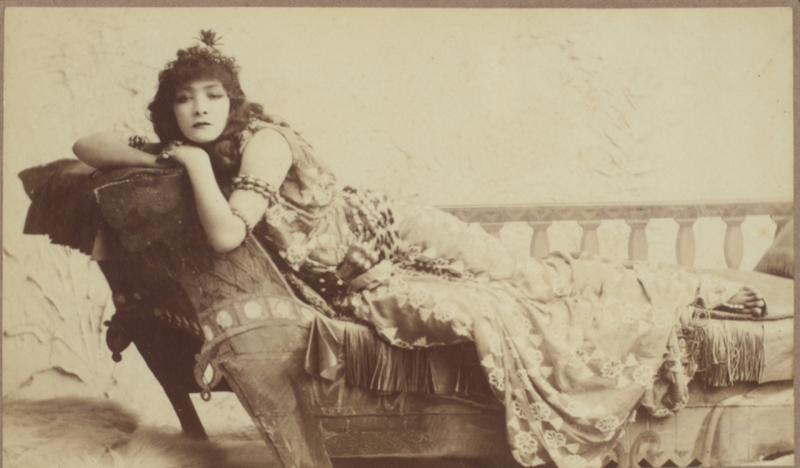
Sarah Bernhardt, pseudonym of Henriëtte-Rosine Bernhardt (Paris, 22 October 1844 – ibid., 26 March 1923), was a French actress of Dutch descent. She was perhaps the most famous actress of her generation.
Bernhardt was born in Paris as the illegitimate daughter of the Dutch jet-set courtesan Julie Bernardt and a Norman father, a lawyer from Le Havre. Her grandfather Moritz Bernardt was a notorious Jewish merchant in Amsterdam.[1] Her aunts on her mother's side were also predominantly courtesans. They all had little to no time for little Rosine, so that her upbringing was left to others. As a girl she was often ill and bedridden, from the age of 15 this became much less. She indicated that she wanted to become a nun in a convent. But it became the Paris conservatory, at the insistence of Charles Duke de Morny; half-brother of Emperor Napoleon III.
Sarah Bernhardt became one of the greatest actresses of her time and remains the greatest French theatre legend in history. She not only performed in Paris, but toured extensively around the world, appearing in London, New York, Amsterdam and Antwerp.
She had an affair with a Belgian nobleman, Charles-Joseph Eugène Henri Georges Lamoral de Ligne (1837–1914), son of Eugène de Ligne (8th Prince de Ligne), with whom she had her only child: son Maurice Bernhardt (1864–1928). Maurice did not become an actor, but worked most of his life as a manager and agent for various theatres and actors, including his mother.
In 1899 she took over the prestigious Théâtre Lyrique on the Place du Châtelet in Paris. She renamed it Théâtre Sarah-Bernhardt and performed there for over twenty years. Even after her death, the name was maintained, except during the Second World War, when the name had to be removed because of her Jewish origins. Today, the theatre is known as Théâtre de la Ville - Sarah Bernardt.
Bernhardt owned a considerable collection of jewellery, which was dispersed after her death. She regularly commissioned René Lalique to design jewellery for her